FAQ
What should I expect during physical therapy sessions?
At Anthrokinetics Physio Lab, we pride ourselves on a more in- depth approach that utilizes a “build, perform, recover” framework, leveraging tools typically only found in advanced research labs:
- Dynamometers for objective strength testing
- 3D inertial sensors for motion capture
- Surface electromyography for real-time muscle performance
- 3D force plates to measure kinetics and ground reaction forces
- Computer vision with synchronized sensors to display things like direction of force, muscle performance biofeedback, and more.
We do this so we can truly bring research-grade approaches to clinical practice
Do I need a referral from my doctor before attending Physical Therapy?
North Carolina has Direct Access for Physical Therapy (PT), meaning you can see a physical therapist for evaluation and treatment without a doctor’s referral, enabling faster care for movement issues, but restrictions apply, such as the therapist must refer you out if the condition is outside their scope (e.g., spine manipulation requires a prescription), and insurance coverage often still needs a physician’s plan for payment.
What do I need to wear or bring with me?
Is there anything I can do before my appointment to prepare?
How long will my physical therapy sessions last?
If you are coming in for a strength-only appointment, typically you can get through your prescribed routine in 30 minutes.
Are there any exercises I can do at home between appointments to help improve my condition?
Yes! Your physical therapist may provide specific exercise recommendations for you to try in between visits, which will help speed up your recovery and progress faster toward reaching your goals. It’s important to follow these carefully and always check with your PT before starting a new exercise program if you have any questions or concerns.
Often, our PTs will generate home exercise programs that can be accessed in the Move Health+ app
What if I have questions after my physical therapy session?
You can also login to the client portal and message us there
How often will I need to attend physical therapy sessions?
The frequency of visits will depend on your individual goals and condition, but typically it is recommended that patients attend 2-3 times per week for a minimum of 4-6 weeks in order to maximize results. Your therapist will provide more details during your initial appointment.
How long will it take for me to see results?
Every person’s situation is unique; therefore the amount of time needed to reach goals varies. With commitment and dedication from both you and your physical therapist, you can expect to start seeing results within a few weeks. The more positive lifestyle changes you make, the faster your progress will be!
Will my physical therapist be able to answer any questions I have about my condition?
Yes! Your physical therapist should be available to discuss any concerns or questions you have regarding your condition or treatment plan. Don’t hesitate to bring up any issues that may arise during the course of therapy.
What if I feel too much pain during a session?
If at any time during your physical therapy session you experience increased pain, it’s important to let your therapist know so they can adjust the intensity or technique as necessary. Your therapist will work with you to make sure that treatment is comfortable and effective for you
How will I know when I no longer need physical therapy?
Your physical therapist should be able to provide guidance on when it is appropriate to stop attending physical therapy sessions based on your progress, goals, and overall health status. It’s important to listen to your therapist and continue with treatment until they feel you are ready to move on.
What Does a Typical Kinematic Assessment Entail?
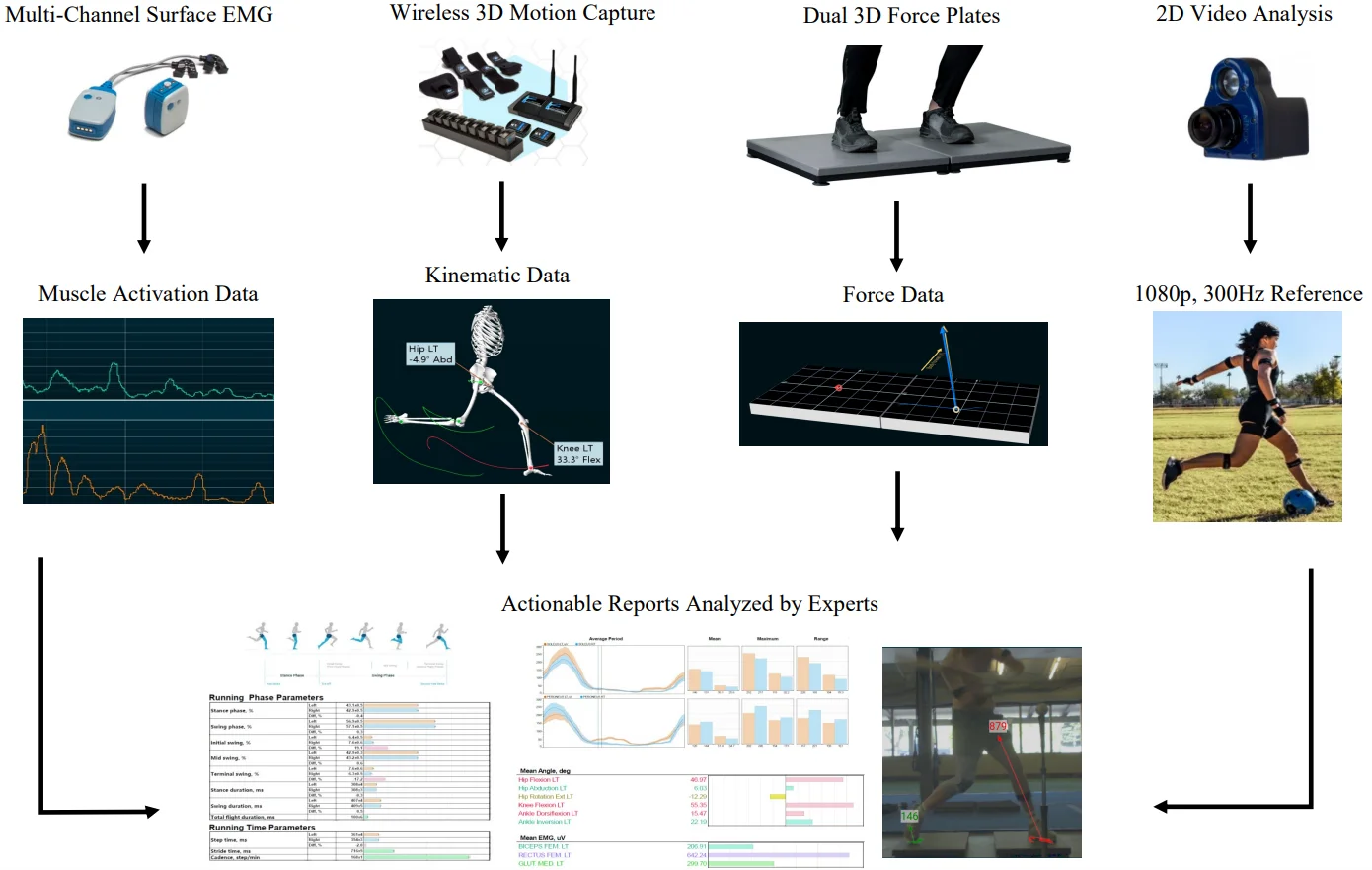
This is a highly customized service that involves the application of various sensors to capture movement, muscle performance, force, video, and pressure data to analyze particular movements. Data collection is typically 90 minutes and often will require back-end processing to generate actionable reports. The specifics will be tailored to your case, and you can discuss details with your provider.
Please refer to the chart below for an example of how a multi-sensor setup is utilized:
How Do I Schedule An Appointment?
In most cases, appointments are booked in bulk at the start of a treatment plan An initial consultation can be booked online here and our team will reach out to you to finish onboarding. Existing clients can also use this link to access the portal and make new appointments or reschedule.
Of course, you can always give us a call at 919-229-9083
Do You Take Insurance?
I am an out-of-network provider. What this means is that most major insurers have my information on file but I do not bill to insurance directly. Instead, fees are collected upfront and all necessary documentation to submit to your insurance for reimbursement is provided. This documentation is referred to as a “superbill” and contains codes used universally by all payers to process claims. Superbills contain coded diagnostic and treatment information, and thus are classified as protected health information (PHI). To keep this information secure, I provide digital access to them through the client portal within 2 business days of the treatment date.
Your reimbursement is dependent upon your insurance benefits. Not all services are covered. I encourage all of my clients to reach out to their health insurance provider and inquire about their out of network physical therapy benefits to best understand their out-of-pocket effective cost for treatment. As a convenience, I have partnered with Reimbursify to assist with out-of-network submission. You can download the app here, and simply upload your superbill. In addition to providing online self-service access to your superbills through the portal, I try to help answer clients’ questions through this process to make it as easy as possible to access your benefits — however ultimately you are responsible for getting reimbursed.
Moving out of traditional insurance networks was a difficult but thought-out decision. It has enabled better care and better service overall: allowing for longer appointment times, mobile outpatient care, advanced lab services, and more customized treatment plans based on the clients’ needs rather than insurance protocol.
Elaborate on “Technology”
Buzzwords are rampant on the internet and in advertising media, so let’s define “technology” and “data-driven”.
- Technology: Research-grade inertial measurement units (IMUs), surface electromyography (sEMG), camera(s), pressure sensors, and force plates
- Data: Joint positions, segmental/angular velocities, muscle activation, pressure, and force-vector outputs during static or dynamic tasks — all synchronized and verified with reference video.
This equipment enables replication of existing research studies to compare output data to published findings, and helps guide evidence-based, data-driven clinical decision making. Reliable, repeatable measurement of variables is necessary for management or meaningful diagnostics. This data also enables the ability to measure improvement objectively to verify or falsify effectiveness of treatment. This is often critical to long-term success.
Since the lab is free-form and portable, almost any static or dynamic task can be captured. I welcome ideas from clients and collaborators on different ways to utilize the various components. Parts of the lab can also be utilized during treatment sessions for movement retraining and biofeedback. Check out the case examples page to get an idea of how the tech has been utilized to inform or solve unique scenarios
Do You Work With Other Healthcare Professionals or Coaches?
Yes! Interdisciplinary communication is vital to overall health and performance management. I welcome collaboration with your other professionals in the community — coaches, physicians, dieticians, mental health therapists, trainers, sports scientists, and more.
Lab reports are written with the intent to be handed to other professionals should they desire to use the information. Traditional physical therapy offices that are not able to offer these lab based services can still utilize this information to guide standard treatment. If you are getting PT elsewhere, a kinematic assessment can be a great extension service to ensure the best results with your current physical rehabilitation solution.
Are you recovered from surgery, done with PT, but still unsure about returning to high level sport, work, or recreation? I encourage verifying or assessing if you’re ready for safe return.
Do You Do One-Offs / Second Opinions?
Yes. Part of being a licensed Doctor of Physical Therapy involves training in screening for non-musculoskeletal disorders and referring to the appropriate provider if necessary. You can see a physical therapist without prescription in North Carolina under Direct-Access. Should you require further physician or non-physician services, you will be referred appropriately.
Completed a treatment plan elsewhere but still experiencing problems? Send a message to request a consult so we can discuss and ensure all options were explored
I Don’t See My Superbill
Superbills can be accessed through the client portal. If more than 2 business days have passed since the treatment date and you cannot view your superbill, send me a message through the portal and I will be happy to get you a PDF copy and troubleshoot your access.